Sediments

and

Flame Structures

For millions of years the rivers that laid down the sediments that formed the underlying bedrock were a combination of meandering rivers and deltas leading into the sea.The conditions tended to be fairly stable over long periods of time but with the changes brought about by the effects of the earthquakes, a dramic change in the river flow occurred.

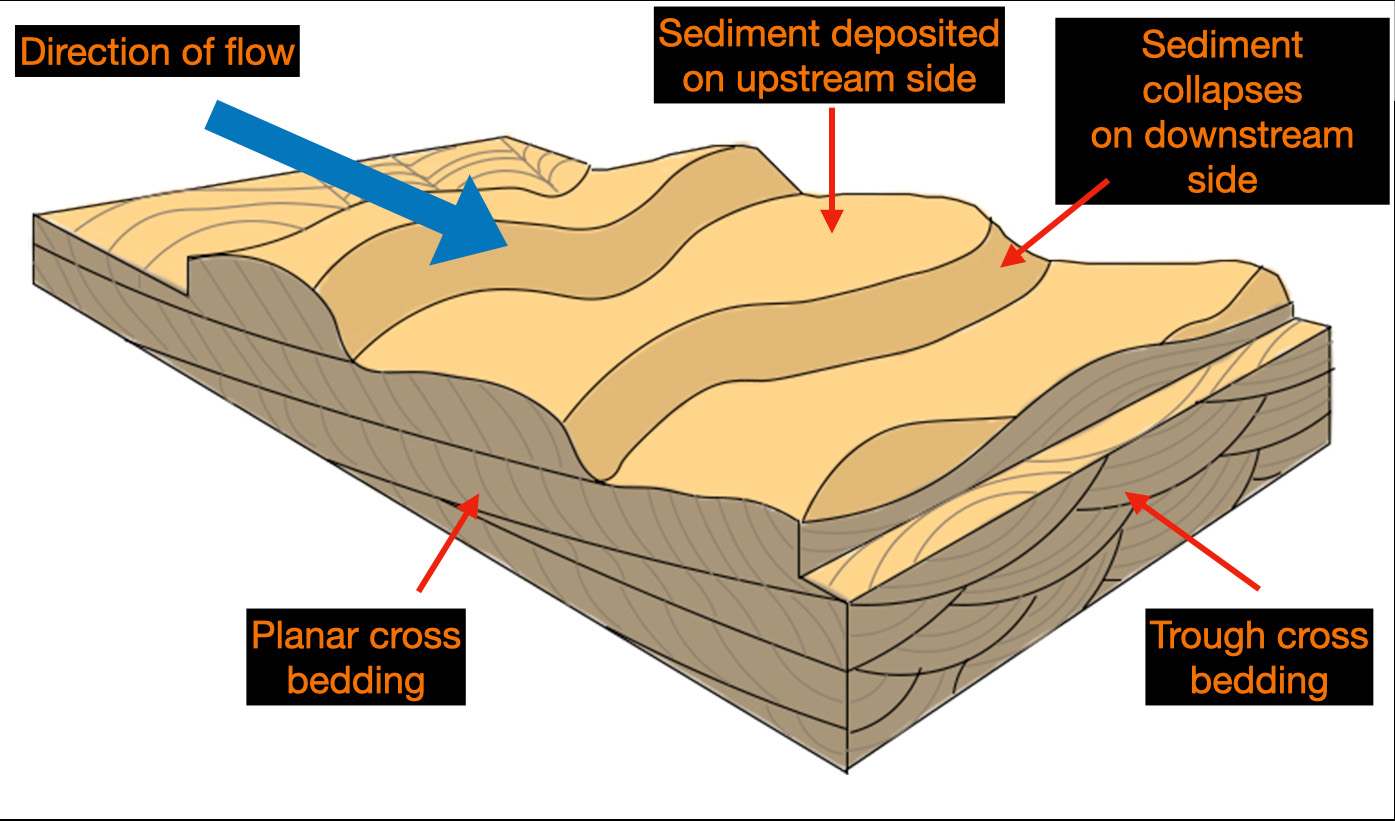
As river deposited sediments on the river bed, river currents created a series of ridges and troughs where sediments were continualy being laid down.

Stephen Lewis

The Boat Rock.

The Dancing Bear.

Bedding Planes

A characteristic feature of many of the rock outcrops are layers called bedding planes which are indicative of sediments laid down by rivers.
Deformation Structures

The transformation of soft sand to solid rock is a long process during which time the sediments may be subject to various factors that can move and deform the layers whilst they solidify. At Brimham can be found sections of rock where these effects can be clearly seen.

Stephen Lewis

Complex flame structures.

The diagram below identifies a few of the noticable flame structures and the load casts associated with the process that formed them. This process is known as bedform dewartering and occurs when pressure is exerted on the top layers of the mobile sediment layers.

Phase 1

Impact

The process starts.

Phase 2

Liquefaction

The process starts.

Phase 3

Pressure builds

The process starts.

Phase 4

Deformation complete

The process starts.