Millstone Grit

Stephen Lewis
A view of the massive gritstone blocks exposed on the western edge of the escarpment.
Millstone Grit
The dramatic landscape of much of northern England is formed by the underlying rock called Millstone Grit, a sedimentary rock composed of sharp grains of quartz, the constituent material of sand, which are angular in shape with sharp edges, cemented together by the mineral feldspar.
Stephen Lewis
A view of the massive gritstone blocks exposed on the western edge of the escarpment.
Quartz is the main mineral constituent of the rocks and is composed of silica, silicon atoms combined with oxygen as silicon dioxide, and is remarkably resitant to weathering. In the Millstone Grit at Brimham the quartz ranges in size from tiny fine grains to larger pebbles. Also present is feldspar, a mineral comprising silicates but combined with auminium and other elements such as sodium, calcium or potassium. This acts as the cement gluing the sand grains together.
Another mineral found in these rocks, but in minute quantities, is zircon, the grains of which have been dated to between 3,743 and 377 million years old which relates to when the mineral itself was formed. You can find additional information on how zircon can tell us more about Brimham here.

Stephen Lewis
At Lovers Leap, massive blocks of Millstone Grit above the cliffs form spectacular features.
Lover’s Leap
Millstones
The bedrock underlying the site is a gritty type of sandstone called Millstone Grit. A mixture of quartz and feldspar, rocks of this type were used to make the millstones for grinding wheat from which it gets its name.
The sharp quartz crystals are the cutting surfaces that break up the grains and grind the seeds into flour.
Stephen Lewis
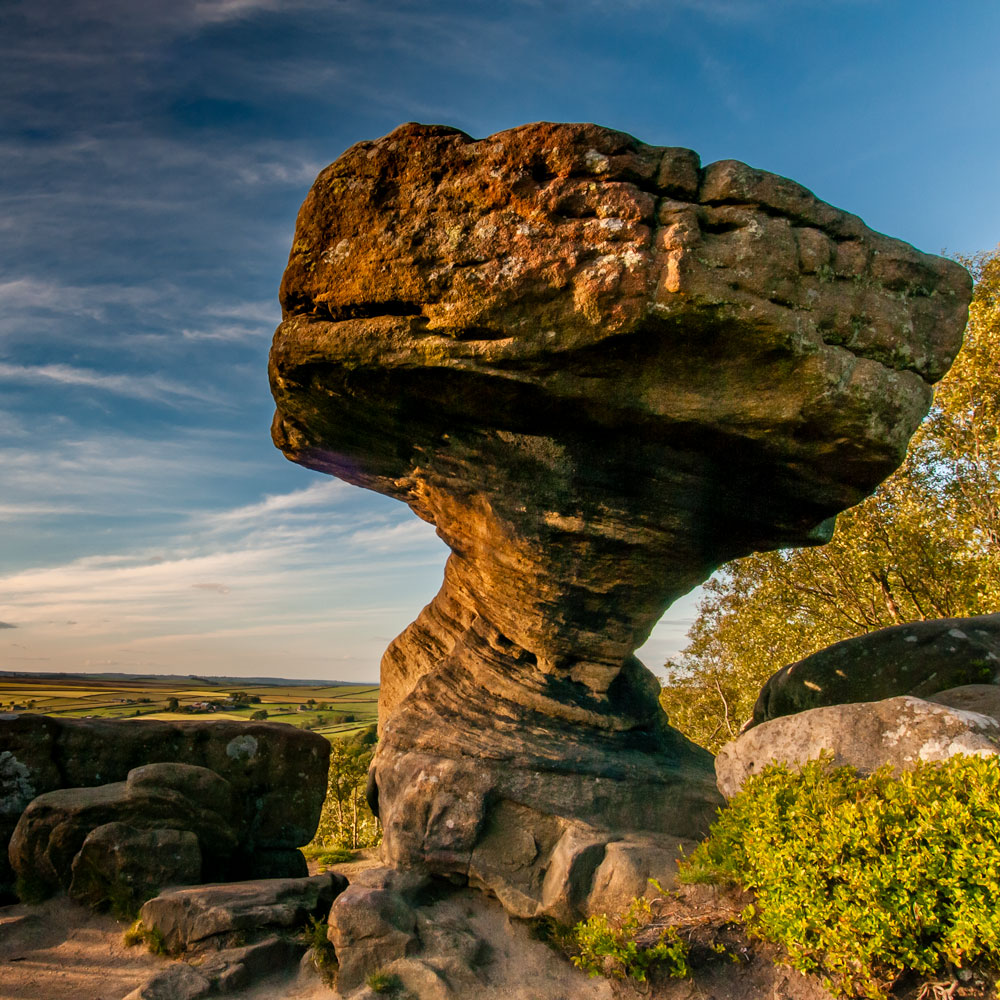
The Druid’s Writting Desk is an excellent example of a weathered tor.
The Druid’s Writing Desk
Rock Pillars
Pillars of rock called tors left by the ravages of the last ice age have been eroded by the effcts of ice and wind into remarkable shapes.
Learn more about the physics behind the creation of these rock shapes.

Stephen Lewis
One of a number of arches and holes carved out of the rock by the effects of weathering.
Rock arch
Rock Arches
Where outcrops have been left exposed to the weather, wind erosion has created a series of holes, some many feet long, and various arches apparently carved into the rock.

Stephen Lewis
Perhaps Brimham’s most iconic rock.
The Idol Rock
Wind Erosion
Perhaps the most extreme example of the effects of wind erosion is the remarkable Idol Rock, a huge block apparently balancing on a tiny pedestal, though in fact it is one single block.

Stephen Lewis
A rock outcrop close to the Mushroom Rock.
The Boat Rock
Bedding Planes
Looking like waves frozen in time, bedding planes are visible in many of Brimham’s rocks, such as these that form the layers of the Boat Rock.
Learn more about how river currents created these bedding planes.