Rivers
Rivers
and
Valleys
The power of water
For millions of years the rivers that laid down the sediments that formed the underlying bedrock were a combination of meandering rivers and deltas leading into the sea. The conditions tended to be fairly stable over long periods of time but with the changes brought about by the effects of the earthquakes, a dramic change in the river flow occurred.
The Fluvial System
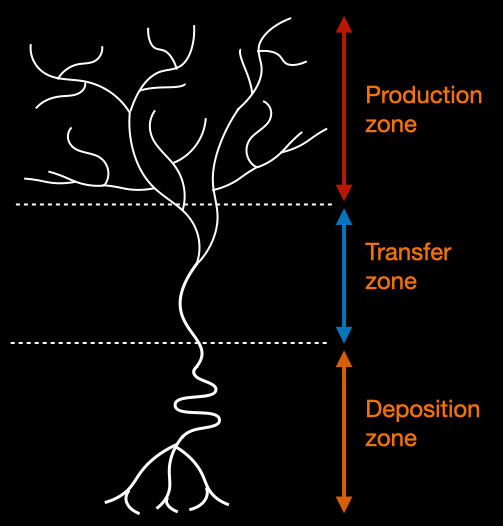
The diagram below illustrates the 3 zones of a typical river system, a concept introduced by Stanley Schumm in the 1970’s, which characterises each zone as having a fundamental property.
The first, the production zone, exists in the high mountain environment where the erosion of the rocks is at its maximum. The second, the transfer zone, moves the sedimentary clastic material from the highlands through the lowlands and lower valleys. In the third zone, the deposition zone, the energy of the river can no longer move the material and it is deposited in the river bed and in deltas as it approaches the sea.
The mountains are eroded by rain, ice, snow and glaciers and steep slopes, v-shaped valleys, waterfalls and rapids contribute to further erosion.
Streams and rivers coalesce with enough energy to carry debris further downstream.
The river loses energy and meanders; the erosion debris is deposited on floodplains, deltas and coastal plains.
Brimham’s Ancient River System
The ancient river systems had their origins in the mountain range well to the north of what is now Britain and flowed in a southerly direction bringing sediments eroded from those mountains, the Zone 1 Production zone, down through the Zone 2 Transfer zone reaching northern Britain.
The influence of shifts in the slope of the ground led to changes in the river from a meandering river to a braided river system.
As the river deposited sediments on the river bed, the currents created a series of ridges and troughs within the sediments as they were continualy being laid down.
Stephen Lewis
The Boat Rock.
These sedimentary proceses created the conditions for the strata and bedding planes visible on the rock outcrop called the Boat Rock. To dig into more information about these sediments click here.