Earthquakes

Stephen Lewis
The Eagle Rock.
Earthquakes
One of Nature’s most powerful events.
Stephen Lewis
The Eagle Rock.
The planet is dynamic and the apparently solid continents are continuously moving as the tectonic plates are driven by heat rising from the immensely hot interior.
Three massive granite bodies, called batholiths or plutons, lie under the north of England. These are relatively immovable and define the orientation of the fault lines.

The Craven Fault system runs north to south but splits off as the North Craven Fault towards the east past Pateley Bridge and Brimham.

Along these fault lines earth movements generate earthquakes which had a profound effect on the flow of the ancient river that was depositing sediments.
As Charles Darwin noted "The Craven Fault, for instance, extends for upwards of 30 miles, and along this line the vertical displacement of strata has varied from 600 to 3000 feet."
Still active, a stong earthquake in January 1933 affecting Wensleydale, December 1944 Skipton causing minor damage, and as recently as March 2025 a magnitude 2 quake at Kilnsey.
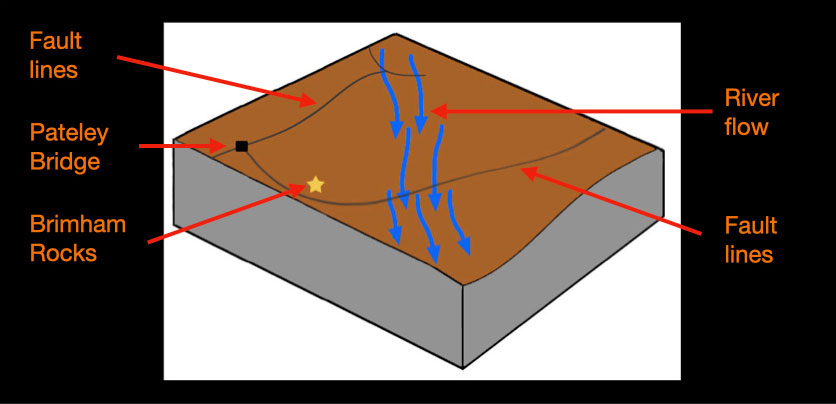
Before the earthquake the river flow was in a North to South direction over a wide valley. The topography of the ground is not materially affected by the underlying fault lines.
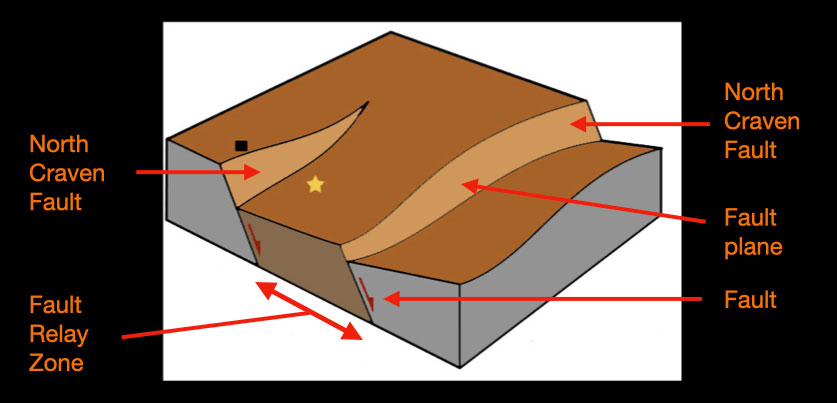
The earthquake generates a series of land slips exposing large fault planes which follow the lines of the North Craven Fault and a Fault Relay Zone is created.
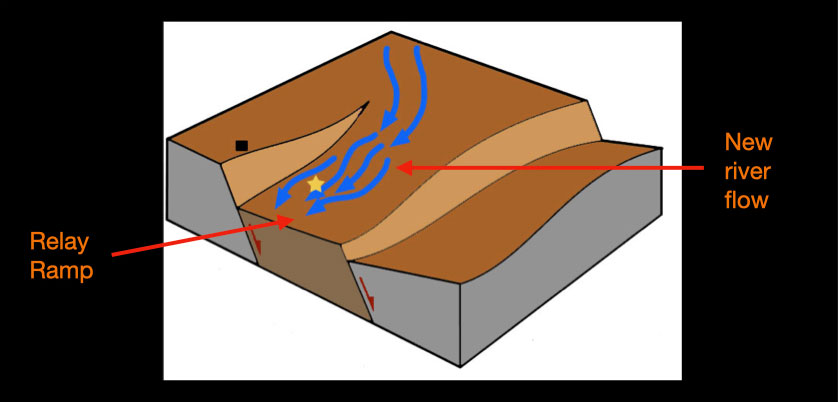
Within the fault relay zone the river now flows down the relay ramp in a westerly direction. Not only that but the river flow became faster and far more dynamic changing from a meandering river to a braided river system.